

Sourcing natural coir mats from India is one of the smartest inventory decisions you can make for your home decor, hardware, or commercial floor-covering business. India—specifically the coastal belt of Alleppey and Cochin in Kerala—produces over 80% of the world’s natural coir products. However, if you are buying in bulk container loads or managing high-volume B2B shipments, you know that missing a single specification detail can lead to high product return rates, shedding complaints, or mold issues during ocean transport.
Whether you are an international importer, a regional wholesaler, or a commercial buyer, this step-by-step coir mat quality checklist will help you conduct a watertight coir doormat quality inspection before your shipment leaves the factory floor.
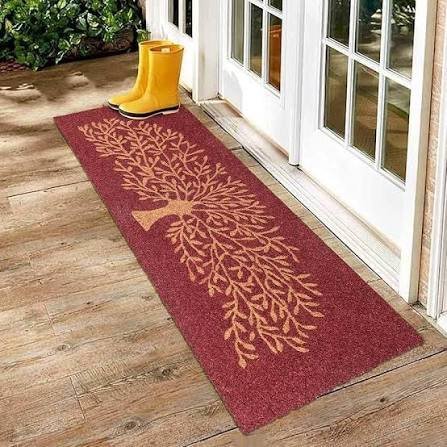
Quick Coir-Mat Quality Specification Table
To help you quickly benchmark specs when sourcing wholesale coir mats India, here is an overview of industry-standard quality parameters:
| Quality Parameter | Standard Commercial Grade | Premium Export Grade | Inspection Method |
| Coir Fibre Grade | BC2 / Mixed Coir Fibre | BC1 / Golden Anjengo Fibre | Visual inspection & colour grading |
| Total Weight / GSM | 5,000 GSM} – 5,500 GSM | 5,800 GSM} – 6,500 GSM | Digital scale (40 x 60 cm sample) |
| Pile Height | 15 mm +/- 1 mm | 17 mm – 22 mm +/- 1 mm | Vernier caliper / Depth gauge |
| Backing Type | PVC (Polyvinyl Chloride) / Latex | Heavy-Duty Non-Slip PVC / Natural Latex | Cross-hatch adhesion & flex testing |
| Dimensional Tolerance | +/- 5 mm | +/- 2 mm to +/- 3 mm | Steel measuring tape |
| Moisture Content | Below 15% | 10% – 12% | Digital pin-type moisture meter |
| Shedding Limit | Moderate initial loss | Minimal initial shedding | Manual brush test / Tap test |
1. Fibre Quality and Colour Assessment
The base material determines how long a coir mat lasts and how well it accepts printing or dye. Natural coir fiber is extracted from coconut husks, but not all husks yield the same quality.
- Golden Fibre (Unbleached Premium): High-grade coir is spun from green or semi-ripe husks soaked in clean freshwater. It has a natural bright golden-brown hue, long individual fibres, and low pith content.
- Dark / Brown Fibre: Extracted from dry husks or retted in brackish water, this fibre is darker, coarser, and can carry a slight salty residue if not washed thoroughly.
- Pith and Impurities: Check the pile closely. Excessive dark speckles, dust, or short broken fibers (pith) indicate low-grade fibre processing. High pith content weakens the pile and increases shedding.
2. Mat Weight and Coir Mat GSM Standards
Weight is a direct proxy for structural density and durability. In the floor covering industry, density is measured in coir mat GSM (Grams per Square Metre).
When evaluating bulk samples, never negotiate on pile density. A lighter mat might cut shipping costs, but it will flatten quickly under foot traffic and shed excessively.

For a standard 40 cm x 60 cm mat (0.24 sq m):
- At 5,500 GSM, the mat should weigh approximately 1.32 Kg
- At 6,000 GSM, the mat should weigh approximately 1.44 kg
Always weigh at least 10 random mats per batch on a calibrated digital scale during your coir doormat quality inspection.
3. Pile Height and Density Measurement
Pile height affects both scraping efficiency and doorway clearance.
- Standard Thicknesses: 15 mm, 17 mm, 20 mm and 24 mm
- Density Test: Push your fingers directly into the tufted pile. If you can easily feel the backing base or spread the fibers apart with minimal effort, the tufting gauge (stitches per inch) is too low.
- Uniformity: Use a depth gauge or Vernier caliper across four corners and the center. The height variation should not exceed +/- 1 mm Uneven pile causes printing blurs and premature wear.
4. Decoding BC1, BC2, and BC20 Specifications
If you are reviewing factory quotation sheets from Indian exporters, you will run into yarn codes like BC1, BC2, and BC20. Here is what they mean for your coir mat quality checklist:
- BC1 (Beach Coir Class 1): The gold standard for tufted coir mats. Made from fine, hand-spun or high-precision machine-spun yarn with consistent thickness, bright colour, and minimal debris. Ideal for sharp screen printing.
- BC2 (Beach Coir Class 2): Slightly coarser than BC1 with minor variations in yarn diameter and colour. Works well for plain, unprinted mats or heavy-duty scraper mats.
- BC20 / Lower Grades: Coarse, uneven yarn containing higher moisture and pith content. Generally used for budget utility mats where visual appeal is secondary.
5. Backing Adhesion and Material Integrity
The backing holds the coir tufts in place and prevents slipping on hard surfaces. Most export-grade coir mats use a PVC (Vinyl) or Natural Latex backing.
- The Peel Test: Attempt to manually peel the coir pile away from the PVC backing at the corners. A quality chemical bond requires significant force to separate; if the pile peels off cleanly like a sticker, the curing temperature or compound formula was incorrect.
- Flexibility & Cracking Test: Bend the mat backward (backing side out) along a $90^\circ$ angle. High-grade PVC remains pliable without cracking, whitening, or splitting.
- Edge Trimming: Ensure the PVC border is cut cleanly without excess plastic flashing, air bubbles, or thin spots along the perimeter.
6. Size and Dimensional Tolerance
Mass production on automatic tufting and cutting lines should deliver tight dimensional consistency.
- Standard Export Sizes: 40 x 60 cm, 45 x 75 cm and 60 x 90 cm
- Tolerance Limits: For export markets (especially EU and US retail chains), dimensional tolerance should stay within =/- 3mm to +/- 5 mm in length and width, and 90 degree squareness at all four corners.
- Diagonal Check: Measure diagonally from corner to corner in an ‘X’ pattern. Equal diagonal lengths confirm the mat is perfectly rectangular and not skewed.
7. Shedding Test (Fibre Retention)
Because coir is a natural short-staple plant fiber, initial loose fibers are normal. However, excessive shedding indicates poor tufting insertion or inadequate lock-in during vinyl curing.
- Manual Friction Test: Pass a firm hand over the surface of the mat 5 times in a single direction. Count the loose fibers gathered.
- Tap Test: Hold the mat vertically $10\text{ cm}$ above a clean flat table and drop it once flat on its back. Measure the weight of dropped loose debris. Excessive fiber loss points to weak anchoring in the backing compound.
8. Moisture and Mold Inspection Protocol
Moisture is the primary risk factor when shipping wholesale coir mats India across international sea routes. High ambient humidity combined with organic plant fiber can cause mold, mildew, and foul odors inside closed shipping containers.
- Moisture Limit: The moisture content of the coir pile must strictly remain below 15% with 10% – 12% being the ideal target range for export.
- Testing Method: Insert a dual-pin digital wood/fibre moisture meter deeply into the pile at 5 different locations per sample mat.
- Storage & Handling: Ensure your manufacturer stores finished goods on wooden pallets inside a well-ventilated warehouse, never directly on concrete floors.
9. Print Clarity and Colourfastness Testing
Printed coir doormats with cheerful greetings, seasonal designs, or custom logos are top sellers in retail markets. Inspecting the print quality ensures your visual branding holds up.
- Bleed & Sharpness: Check lines and edges of complex artwork. Spray-printed or stenciled designs should have sharp boundaries without color bleeding between adjacent shades.
- Azo-Free Dyes: Verify that the factory uses REACH-compliant or Azo-free synthetic dyes to meet international consumer safety standards.
- Rub/Friction Fastness: Rub a damp white cotton cloth firmly across the printed design 10 times. Minimal to zero color transfer onto the cloth indicates properly heat-set and cured inks.
10. Sample Approval Process (Gold Sample)
Never commence bulk manufacturing without an approved physical “Gold Sample.”
- Request Counter Samples: Ask the supplier for 2–3 identical pre-production samples.
- Inspect & Sign Off: Test the samples against this checklist. Once satisfied, sign and return one approved sample to the manufacturer, keeping the identical twin at your office as the benchmark.
- Reference Contract: State explicitly in your purchase order (PO) that the bulk production must match the physical approved Gold Sample in weight, GSM, pile height, and color fastness.
11. Pre-Shipment Quality Inspection (AQL Standard)
When ordering container loads, inspect the goods using the Acceptable Quality Limit (AQL) framework (typically AQL Level II, Normal Inspection, General Inspection Level 2.5/4.0).
- Sampling: Randomly select cartons across the entire production batch (top, middle, and bottom of pallets).
- Categorize Defect Types:
- Critical Defect: Active mold, wet mats, missing backing, hazardous chemical odor. (Acceptance limit: 0)
- Major Defect: Out of tolerance dimensions (> 5 mm), wrong design/color, weight below specs by > 5%, severe cracking. (Acceptance limit: lower threshold based on lot size)
- Minor Defect: Minor edge unevenness, slight surface shedding, small color specks.
12. Moisture-Resistant Export Packing
Even perfect mats can ruin during a 30-day ocean voyage if the packaging fails.
- Carton Specifications: Ensure mats are packed in sturdy, 5-ply corrugated master cartons capable of withstanding stack weight inside sea containers.
- Poly-Bags & Desiccants: Individual or master poly-bagging with silica gel desiccant packs is highly recommended to absorb residual atmospheric moisture.
- Palletization: Pallets should be shrink-wrapped with corner edge protectors to prevent crush damage during forklift movement.
13. Questions to Ask Your Indian Coir Supplier
Before issuing a deposit or opening a Letter of Credit (LC), ask your vendor these critical questions:
- “What fibre grade (BC1 or BC2) is calculated in this unit price quotation?”
- “What is the exact target GSM and pile height for this item?”
- “What moisture level testing equipment do you use during final packing?”
- “Are all dyes used in printed mats REACH-compliant and Azo-free?”
- “Do you perform in-house cross-hatch adhesion tests on the PVC backing?”
14. Common Quality Red Flags in Coir Sourcing
Keep an eye out for these warning signs during factory visits or sample evaluations:
- Strong Chemical Odor: Indicates low-grade recycled plasticizers or improper curing in the backing layer.
- Uneven Shearing: Visible ridges or wavy surfaces across the top of the coir pile.
- Dusty Powdering: Light-brown powder falling out when you shake the mat, pointing to untreated coir pith.
- Brittle Backing: Cracking or flaking edges when folded gently.
- Price Too Good to Be True: Usually means the supplier reduced the GSM or blended high amounts of low-grade pith with short fibers.
Downloadable 15-Point Supplier Inspection Checklist
Keep this quick reference handy for your quality control team or third-party inspection agencies:
[ ] 1. Fibre Type: Golden/Bright BC1 or BC2 grade coir verified
[ ] 2. Fibre Pith Content: Minimal dust and husk debris observed
[ ] 3. Mat Weight / GSM: Meets agreed spec (e.g., 5800-6000 GSM ± 3%)
[ ] 4. Pile Height: Uniform across all 4 corners (measured via caliper)
[ ] 5. Dimensional Size: Length, width, and squareness within ±3mm
[ ] 6. Diagonal Measurement: Equal corner-to-corner distance confirmed
[ ] 7. Backing Adhesion: Strong bond; no easy peel-off from PVC layer
[ ] 8. Backing Integrity: No cracks or splits when bent to 90 degrees
[ ] 9. Moisture Content: Strictly below 15% (Target: 10% - 12%)
[ ] 10. Shedding Test: Passed manual rub and tap test limits
[ ] 11. Print Quality: Sharp lines, no color bleeding, correct design
[ ] 12. Colorfastness: Passed wet-cloth rub test without dye bleeding
[ ] 13. Odor Check: Neutral natural scent; no harsh chemical smell
[ ] 14. Packaging Integrity: 5-ply cartons, desiccant packs present
[ ] 15. Outer Labelling: Correct SKU, barcode, and origin markings
Frequently Asked Questions
What is the standard GSM for export-quality coir mats?
Most standard commercial tufted coir mats range between 5,000 GSM and 5,500 GSM, while premium export-grade mats range from 5,800 GSM to 6,500 GSM. Higher GSM yields better durability and minimal pile flattening over time.
How do you keep coir mats from molding during sea shipment?
Ensure the manufacturer packs goods at a moisture level below 12%. Use moisture-absorbent silica gel desiccant packs inside sealed master polybags, pack mats in clean 5-ply cartons, and ensure the shipping container is fitted with container desiccants (dry bags) to avoid “container rain.”
What is the difference between BC1 and BC2 coir yarn?
BC1 (Beach Coir Class 1) is a finer, brighter, more uniform yarn made from high-grade fibers, making it ideal for smooth, high-definition printing. BC2 is a slightly coarser yarn with subtle natural color variations, suitable for plain utility or heavy-duty scraper mats.
By using this structured coir mat quality checklist, you can secure consistent product quality, protect your profit margins, and build strong relationships with trusted manufacturers when sourcing wholesale coir mats India.
