

Buying a beautiful rug is easy. Buying one in the right size is where things become confusing.
Should the sofa sit completely on the rug? Is 5 × 8 ft enough for a three-seater? How large should a rug under a king bed be? And what happens when the shop gives dimensions in centimetres while you measured your room in feet?
This rug size guide India is designed to answer exactly those questions.
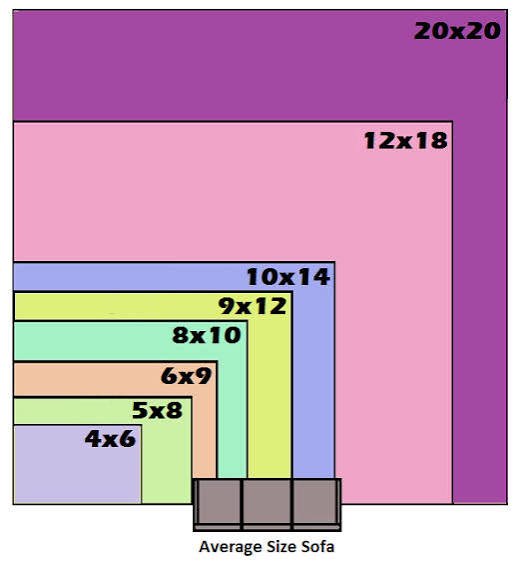
Instead of assuming that every home has a huge living room, we have considered the layouts most Indian buyers actually deal with: compact apartments, 2BHK and 3BHK living rooms, three-seater sofas, combined living-dining spaces, queen and king beds and relatively narrow passages.
Let us start with the numbers.
Quick Rug Size Guide India: Room-by-Room Chart
Use this table as a starting point. Always measure your actual furniture before ordering.
| Area | Recommended Rug Size | Approx. Size in CM |
|---|---|---|
| Small seating corner | 4 × 6 ft | 122 × 183 cm |
| Compact living room | 5 × 7 / 5 × 8 ft | 152 × 213 / 152 × 244 cm |
| Three-seater sofa, front legs on rug | 6 × 9 ft | 183 × 274 cm |
| Standard living room | 8 × 10 ft | 244 × 305 cm |
| Large living room | 9 × 12 ft | 274 × 366 cm |
| Queen bed | 8 × 10 ft | 244 × 305 cm |
| King bed | 9 × 12 ft | 274 × 366 cm |
| Compact 4-seater dining table | About 6 × 9 ft | 183 × 274 cm |
| 6-seater dining table | About 8 × 10 ft | 244 × 305 cm |
| 8-seater dining table | About 9 × 12 ft | 274 × 366 cm |
| Hallway runner | 2–2.5 × 6–10 ft | About 60–80 × 180–300 cm |
One important point: Indian shops increasingly use metric dimensions. A rug labelled 160 × 230 cm is not exactly a 5 × 8 ft rug, and a 200 × 300 cm rug is not exactly 8 × 10 ft. That is perfectly normal. Buy according to the space available rather than worrying about matching an imperial size exactly. Current Indian retailers commonly stock sizes such as 120 × 180, 133 × 195, 160 × 230, 170 × 240 and 200 × 300 cm. (IKEA)
How to Measure a Room Before Buying a Rug
A good rug size guide India can give you recommended dimensions, but measuring your own room is still essential.
Start by measuring:
- the length and width of the room;
- the width of your sofa;
- the distance between sofa and opposite chairs;
- the size of the bed or dining table;
- available walking space around the furniture;
- doors that need to open across the rug.
Do not buy a rug simply because its dimensions sound large enough.
Instead, use masking tape or newspaper to mark the rug dimensions directly on the floor. Leave it there for a few hours and walk around the room normally.
You will immediately see whether the rug looks balanced or whether it blocks a doorway, leaves too little exposed flooring or seems too small once furniture is placed around it.
This little test can save a surprisingly expensive mistake.
Living Room Rug Size India: What Works in Indian Apartments?
The most common living-room mistake is buying a rug that sits like a small island under the coffee table.
A living room rug should visually connect the sofa and surrounding chairs. It should not look disconnected from them.
For most Indian apartments, there are three practical layouts.
Compact Living Room Rug Size
If your living room is small, a 5 × 7 ft or 5 × 8 ft rug may be enough.
In metric sizes, look for approximately:
- 150 × 210 cm;
- 150 × 240 cm;
- 160 × 230 cm.
These sizes work particularly well where the sofa is placed against a wall and you mainly want the rug beneath the coffee table and extending towards the sofa.
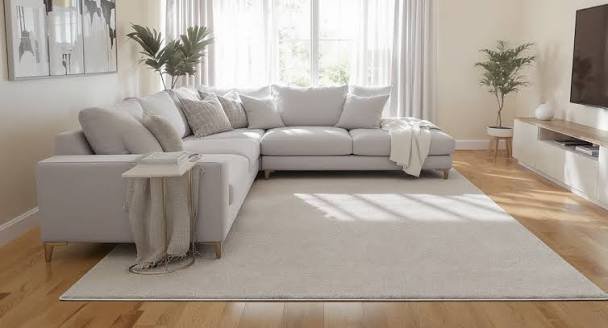
However, try to get at least the front legs of the sofa onto the rug.
If the rug floats entirely in front of the sofa, the seating arrangement can look fragmented.
Rug Size for a Three-Seater Sofa
There is no single standard size for every three-seater sofa, so measure yours before shopping.
As a general rule, your rug should be wider than the sofa rather than narrower than it.
For a typical three-seater arrangement:
6 × 9 ft (about 183 × 274 cm) works well where the sofa’s front legs sit on the rug.
For a more spacious room:
8 × 10 ft (about 244 × 305 cm) creates a much stronger visual anchor and can accommodate the sofa plus side chairs more comfortably.
When using this rug size guide India, don’t focus only on the number printed on the label. Look at how the rug connects the complete seating arrangement.
Front-Legs-On vs All-Legs-On Rug Placement
These are the two most useful living-room layouts.
Front Legs on the Rug
The front legs of the sofa and chairs rest on the rug while the back legs remain on the floor.
This is usually the best arrangement for compact and medium-sized Indian living rooms.
It connects the furniture without requiring an enormous rug.
A 6 × 9 or 8 × 10 ft rug often works well.
All Furniture Legs on the Rug
The sofa, armchairs and coffee table all sit completely on the rug.
This works beautifully in larger rooms and open-plan houses because it clearly defines the seating area.
You will normally need an 8 × 10, 9 × 12 ft or larger rug, depending on the furniture.
Avoid squeezing every piece onto a rug that is only just big enough. Some visible rug should extend beyond the furniture.
How Much Floor Should Show Around a Living Room Rug?
You do not need to cover your entire floor.
In fact, allowing some marble, wood, terrazzo or tile to remain visible gives the room definition.
In a spacious room, roughly 30–45 cm of visible flooring between the rug and walls often looks balanced.
In a compact apartment, this can be reduced.
Symmetry matters more than following an exact number. A reasonably even border normally looks better than having the rug almost touch one wall while leaving a huge gap beside another.
Rug Size for Queen Bed
For most queen-bed arrangements, 8 × 10 ft is the safest general recommendation in this rug size guide India.
Place the rug horizontally beneath the bed so that it extends beyond both sides and the foot.
There are two common methods.
Full Bed Placement
The rug sits under most or all of the bed.
An 8 × 10 ft rug gives a finished hotel-style appearance in many bedrooms.
Lower Two-Thirds Placement
Instead of starting behind the headboard, position the rug roughly halfway or two-thirds up the bed.
This places the rug where it is actually useful: beside the bed and beneath your feet when you get up.
It also lets you use a smaller rug.
This arrangement is especially useful in Indian bedrooms where bedside tables sit close to walls or cupboards.
Best Rug Size Under King Bed
The safest rug size under king bed is generally 9 × 12 ft, or around 274 × 366 cm.
An 8 × 10 ft rug may work if you position it beneath the lower portion of the bed, but it offers less coverage at the sides.
For a large bedroom, 9 × 12 ft creates better proportions.
Remember that Indian mattress and bed-frame dimensions vary between manufacturers. Do not assume that something described as a “king-size bed” has exactly the same dimensions everywhere.
Measure the complete bed frame, not only the mattress.
Ideally, you want enough rug visible on both sides for your feet to land comfortably on it.
Alternative for Small Bedrooms
If there is not enough room for a large rug, use:
- one runner on each side of the bed; or
- a smaller rug across the foot of the bed.
This gives you warmth and texture without crowding the room.
Dining Table Rug Size: The 60 cm Rule
Dining rugs require a slightly different approach.
The rug must remain under the chairs even after someone pulls a chair backwards to sit down.
That is why the table itself should never determine the rug size.
Measure your dining table and add approximately 60 cm on every side.
In other words:
Rug length = table length + around 120 cm
Rug width = table width + around 120 cm
This gives dining chairs space to move without their rear legs constantly falling over the edge of the rug.
Rug Size Under a Four-Seater Dining Table
For a compact four-seater table, start around 6 × 9 ft.
Some very small dining tables may work with a smaller rug, but always perform the pulled-out-chair test first.
A 5 × 8 ft rug can easily become too narrow once chairs are moved backwards.
Rug Size Under a Six-Seater Dining Table
For most six-seater rectangular tables, an 8 × 10 ft rug is a useful starting point.
Again, calculate using the table dimensions rather than the number of seats alone.
Two six-seater tables can have completely different lengths.
Rug Size Under an Eight-Seater Dining Table
An eight-seater will commonly need around 9 × 12 ft.
For particularly long dining tables, go larger.
The aim is simple: nobody should have to lift a chair over the rug edge every time they sit down.
For everyday Indian dining areas, a flatwoven or relatively low-pile rug is also easier to move chairs across than a very thick shaggy rug.
Hallway Runner Rug Dimensions
Indian apartment passages can be narrow, which makes runners useful.
Common dimensions include:
- 60 × 180 cm;
- 70 × 240 cm;
- 80 × 240 cm;
- 80 × 300 cm.
Try to leave approximately 10–15 cm of flooring visible on either side rather than covering the passage wall-to-wall.
The runner also does not need to stretch from one wall to the other. Leaving some floor visible at each end makes it look intentional rather than like incorrectly fitted carpet.
Rug Sizing for Studio Apartments and 1BHK Homes
A rug is particularly useful in an open studio because it can visually create rooms without actual walls.
For example, a 160 × 230 cm rug beneath the sofa and coffee table can define the living area while leaving the dining or sleeping zone separate.
The key is not to buy the largest rug your room can physically accommodate.
Instead, decide which zone you want to define.
In a small studio:
- use one medium rug for the living area;
- keep major walking routes clear;
- avoid pushing the rug underneath unrelated furniture;
- use runners or small rugs elsewhere rather than one giant floor covering.
A good rug size guide India should help a small room feel more organised, not more crowded.
Standard Rug Sizes: Feet to Centimetres Conversion Chart
Keep this table handy when comparing Indian and international rug listings.
| Rug Size in Feet | Exact Approximate Size in CM |
|---|---|
| 2 × 3 ft | 61 × 91 cm |
| 3 × 5 ft | 91 × 152 cm |
| 4 × 6 ft | 122 × 183 cm |
| 5 × 7 ft | 152 × 213 cm |
| 5 × 8 ft | 152 × 244 cm |
| 6 × 9 ft | 183 × 274 cm |
| 8 × 10 ft | 244 × 305 cm |
| 9 × 12 ft | 274 × 366 cm |
| 10 × 14 ft | 305 × 427 cm |
Do not be surprised when a manufacturer rounds these measurements.
For example, an Indian or European-style metric rug may be sold as 160 × 230 cm rather than 152 × 244 cm.
Choose according to your available space.
Common Rug Placement Mistakes to Avoid
Buying a Rug Too Small
This is the most common problem.
A small rug beneath a coffee table can make the furniture around it appear disconnected.
Where budget and room size permit, going one size larger usually creates a more balanced layout.
Choosing a Rug Narrower Than the Sofa
Your rug size for sofa placement should normally extend beyond the sofa rather than stopping inside its width.
Forgetting About Dining Chairs
Measure the chairs in their pulled-out position, not tucked beneath the table.
Ignoring Door Clearance
Thick rugs can prevent bedroom, balcony or cupboard doors from opening properly.
Check clearance before ordering.
Measuring Only the Room
Furniture arrangement matters more than the bare dimensions of the room.
Two identical rooms may require completely different rugs depending on where the sofa, bed or dining table is positioned.
Mixing Feet and Centimetres
Always convert measurements before purchasing.
A difference of 20 or 30 cm may not sound dramatic online, but it can completely change how a rug sits beneath furniture.
Rugs and Indian Homes: Think About Maintenance Too
Size is important, but so is everyday practicality.
Indian homes may deal with dust, monsoon moisture, pets, children and frequent movement between indoor and outdoor spaces.
Flatweaves and natural-fibre floor coverings can be practical for high-traffic areas, while softer pile rugs are usually more comfortable beside beds and sofas.
If you are comparing rugs, carpets and traditional Indian dhurries, their construction can affect both placement and maintenance.
[Internal link suggestion: Dhurrie vs Rug vs Carpet: What Is the Difference?]
Frequently Asked Questions About Rug Sizes in India
What is the best rug size for a living room in India?
For a compact living room, 5 × 8 or 6 × 9 ft may be enough. For a standard three-seater arrangement, 6 × 9 or 8 × 10 ft usually gives better furniture coverage. Measure the sofa before buying.
What rug size works with a three-seater sofa?
A 6 × 9 ft rug is a practical starting point if only the front sofa legs sit on the rug. An 8 × 10 ft rug gives a more generous look in a larger room.
What size rug should go under a queen bed?
An 8 × 10 ft rug works well for many queen beds. In a smaller bedroom, place a 6 × 9 ft rug under the lower portion of the bed instead.
What is the ideal rug size under king bed?
A 9 × 12 ft rug is the most versatile choice for a king bed. Measure the bed frame because king-bed dimensions are not identical across Indian brands.
How large should a dining rug be?
Measure the dining table and add approximately 60 cm around every side so the chairs remain on the rug when pulled backwards.
Is a 5 × 8 rug big enough for a living room?
It can work in a compact room, particularly with a two- or three-seater sofa against a wall. For a larger seating group, 6 × 9 or 8 × 10 ft will usually look more balanced.
Should all sofa legs be on the rug?
Not necessarily. Putting only the front legs of the sofa and chairs on the rug is a perfectly practical layout and works especially well in compact Indian living rooms.
Should I measure rugs in feet or centimetres?
Use whichever unit your retailer uses, but convert everything before ordering. Many rugs sold in India are labelled in centimetres even though buyers commonly describe room dimensions in feet.
Final Rug Size Checklist
The easiest way to use this rug size guide India is to remember four simple rules.
Measure your furniture, not just the room. Make the living-room rug wide enough to connect the seating. Allow enough rug around a dining table for pulled-out chairs. And for bedrooms, concentrate the rug where your feet actually touch the floor.
Finally, mark the planned dimensions on your floor with masking tape before ordering.
A few minutes spent measuring can make the difference between a rug that simply fits and one that makes the entire room look properly put together.
